

80% of Plateau violence is terrorism, says Mutfwang, urges security overhaul

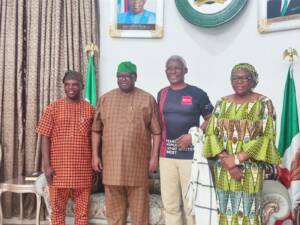 (L-R); Director of Press and Public Affairs to the Governor of Plateau State, Gyang Bere Ph.d; Executive Governor of Plateau State, Caleb Mutfwang; Managing Director and Editor-in-Chief, News Central, Kayode Akintemi, and Commissioner for Information, Plateau State, Hon. Joyce Ramnap, at a State House visit by News Central ahead of the Middle Belt Town Hall in Jos yesterday
Michael Olumide
Governor Caleb Mutfwang has redefined the long-running violence in Plateau State, declaring that the attacks ravaging communities are no longer mere communal clashes but acts of terrorism requiring a decisive national response.
Speaking during an exclusive interview with Managing Director and Editor-in-Chief of News Central TV, Kayode Akintemi, the governor said the scale, coordination, and persistence of the attacks point clearly to a calculated campaign aimed at destabilizing the state and undermining Nigeria’s sovereignty.
“What is happening are acts of terrorism,” Mutfwang stated during the interview at the Government House in Jos. “I can say that 80 per cent of the insecurity challenges on the Plateau are pure acts of terrorism, and we must continue to see these perpetrators as enemies of the state.”
The governor’s remarks mark a significant shift from the long-held narrative that describes the crisis as a communal conflict between local groups.
According to him, the devastation witnessed in areas such as Bokkos and Riyom reflects a level of organization and external backing that goes beyond local disputes over land or resources.
Mutfwang argued that the persistent attacks, often targeting vulnerable rural communities, bear the hallmarks of coordinated terror operations, including strategic planning, mobility across difficult terrains, and sustained funding.
He therefore called on the Federal Government to align with this assessment and recalibrate the nation’s security strategy in the North-Central region. Central to his appeal is the need to review the rules of engagement guiding security forces deployed to Plateau and similar flashpoints.
“Our terrain is extremely challenging,” he noted. “We have vast ungoverned spaces and treacherous landscapes that make access difficult even for security agencies. This is one of the key concerns we have consistently raised with the federal authorities.”
While acknowledging the efforts of security agencies, the governor maintained that more robust, intelligence-driven operations are required to dismantle what he described as entrenched terror networks operating within the state.
During the interview, Akintemi highlighted the humanitarian toll of the crisis, noting that communities across the Middle Belt have endured levels of violence and trauma comparable to war zones.
“We have come to Jos to amplify the voices of the people who have suffered devastating losses,” Akintemi said, stressing the need for urgent and sustained attention to the crisis.
The interview comes ahead of News Central’s highly anticipated Middle Belt Town Hall scheduled for May 7, 2026. The forum is expected to bring together stakeholders to deliberate on the persistent insecurity affecting communities in Bokkos, Mangu, and Jos, among other areas.
Observers say the governor’s reclassification of the violence could have far-reaching implications for national security policy, potentially paving the way for stronger federal intervention, enhanced military engagement, and a shift in how the crisis is perceived both locally and internationally.
As Plateau continues to grapple with recurring bloodshed, Mutfwang’s position signals a growing urgency among state leaders for a more decisive, coordinated, and sustained response to what is increasingly being seen as a national security emergency.



Tinubu has been fair to Ndi-Igbo with several strategic appointments, Abuja Supervisory Councillor
Quest for Ndi-Igbo to align with the ruling All Progressives Congress (APC) at the centre …