

Atiku lacks empathy for national crises, Babachir Lawal alleges

Michael Olumide
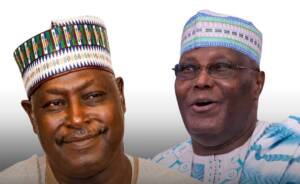
Former Secretary to the Government of the Federation (SGF), Babachir David Lawal, has launched a fresh attack on former Vice President Atiku Abubakar, accusing him of being disconnected from the realities facing ordinary Nigerians while questioning the credibility of opposition coalition politics and internal party processes ahead of the 2027 general elections.
Lawal made the remarks on Tuesday during an interview on Frontline, a current affairs programme on Eagle 102.5 FM in Ilese-Ijebu, Ogun State, where he spoke extensively on opposition realignments, party formation challenges, leadership credibility, and the future of Nigeria’s democratic process.
His comments come barely 24 hours after he officially resigned from the African Democratic Congress, citing what he described as widespread irregularities during the party’s recent presidential primary election.
Lawal had accused the party leadership of manipulating the process to favour Atiku Abubakar, describing the exercise as a “fraudulent charade” and insisting that he would not be part of what he termed a “rigging machine.”
The former SGF further argued that Atiku represented a worse political alternative for Nigeria than incumbent President Bola Ahmed Tinubu.
Although he has yet to announce his next political destination, Lawal disclosed that he has temporarily returned to his home state of Adamawa to consult widely with political associates and supporters before deciding his next move.
His departure from the ADC comes amid growing cracks within the opposition coalition, with notable political figures including Peter Obi and Rabiu Musa Kwankwaso reportedly pursuing alternative political paths ahead of the 2027 elections.
Questions Atiku’s response to national hardship
Speaking during the interview, Lawal maintained that his criticism of Atiku was not driven by personal animosity but by concerns about leadership qualities and public conduct.
According to him, political leaders seeking national office must demonstrate empathy and solidarity with citizens affected by insecurity, terrorism, kidnapping, and economic hardship.
He argued that Atiku has failed to visibly identify with communities devastated by violence and insurgency across the country.
“Have you ever seen Atiku pay condolences to communities where they were ravaged by this insurgency? Never. Have you ever heard him condemn Boko Haram killings? Never,” Lawal stated.
He further contended that leadership requires both physical and emotional presence during national tragedies, stressing that Nigerians deserve leaders who remain engaged with the suffering of ordinary citizens.
Lawal warned that a perceived lack of empathy from political leaders often widens the trust gap between government and the people.
Coalition politics driven by personal ambition
The former SGF also criticised the culture of coalition politics in Nigeria, arguing that many alliances collapse because they are built around personal ambitions rather than national interests.
According to him, politicians frequently join coalitions with the expectation of emerging as the sole presidential candidate, but quickly abandon such alliances once their ambitions appear threatened.
“I don’t know. All Nigerian politicians are all the same. Everybody joins a coalition hoping to become the sole beneficiary. Once they realise that may not happen, they begin to seek alternatives,” he said.
Lawal maintained that this pattern has repeatedly undermined opposition efforts to build strong and sustainable political platforms capable of challenging ruling parties.
Reflects on ADC formation and internal struggles
Recalling his involvement in the formation and growth of the ADC coalition, Lawal said his participation was motivated by a desire to rescue Nigeria from what he described as the damaging effects of current governance policies.
“I was one of the early founding members of ADC, not because I wanted any elective office, but because I believed a coalition was necessary to salvage Nigeria,” he stated.
According to him, the coalition initially attracted broad support from opposition politicians and stakeholders who shared concerns about the country’s direction.
However, he alleged that internal disagreements and competing ambitions eventually weakened the movement.
“We accepted everyone into the coalition and held meetings. But over time, personal ambitions began to overshadow national interest,” he added.
Raises concerns over internal party democracy
Lawal also criticised the conduct of internal party elections and consensus arrangements, insisting that democracy suffers when transparent electoral processes are replaced by manipulation and predetermined outcomes.
He warned that public trust in political parties cannot be sustained if party primaries fail to reflect fairness and credibility.
“We will never be part of anything that truncates democracy in Nigeria. We have seen delegates counted from a few individuals to thousands overnight, and we have seen consensus candidacies where no election took place,” he alleged.
According to him, strong democratic institutions can only emerge when political parties respect due process and allow members to freely choose their leaders.
Evaluates potential opposition figures
Discussing possible opposition candidates ahead of 2027, Lawal said leadership selection should be based on competence, capacity and national acceptability rather than sentiment or political calculations.
He expressed reservations about the electoral prospects of former Minister of Transportation Rotimi Amaechi, arguing that while Amaechi remains a prominent political figure from southern Nigeria, his national appeal remains uncertain.
On Peter Obi, Lawal recalled the complexities surrounding coalition negotiations and efforts to assure the former presidential candidate of fair treatment within opposition discussions.
He noted that Obi’s position within coalition arrangements appeared fluid at different stages, reflecting broader instability within opposition circles.
Lawal, however, reserved special praise for banker and economist Mohammad Hayatu-Deen, whom he described as the most competent among the aspirants he assessed.
“Based on merit, competence and capability, Hayatu-Deen tops them all. He is a well-rounded corporate guru,” Lawal said.
He added that if the opposition eventually settles for a northern candidate, Hayatu-Deen would be his preferred choice.
Questions about Atiku’s political network
The former SGF further criticised the composition of Atiku’s political support structure, arguing that Nigerians should pay close attention not only to campaign promises but also to the networks surrounding political leaders.
According to him, the diversity and inclusiveness of a politician’s inner circle often provide insights into how they may govern if elected.
Lawal claimed that Atiku’s political entourage does not adequately reflect Nigeria’s diversity and argued that leadership should demonstrate broad national inclusion.
He urged voters to scrutinise both the personal and political associations of individuals seeking public office.
Revisits Obasanjo-Atiku political rift
Lawal also revisited the long-running political disagreements between former President Olusegun Obasanjo and Atiku Abubakar.
He argued that the fallout between both leaders reflected deeper concerns about trust, power struggles and governance during their time in office.
According to Lawal, the controversies that emerged from that era continue to shape public perceptions of Atiku’s political journey.
He claimed that investigations and political battles within the administration were influenced by broader struggles for power and control rather than purely administrative considerations.
Defends himself against corruption allegations
Responding to questions about allegations that trailed his tenure as SGF, Lawal maintained that he was vindicated following investigations by the Economic and Financial Crimes Commission.
He insisted that the case against him lacked merit and was eventually dismissed by the court.
“EFCC investigated the matter. My lawyers filed a no-case submission, and the judge dismissed the case. There was nothing to defend because there was no case,” he said.
Lawal maintained that the allegations were politically motivated and designed to force him out of office.
Calls for leadership based on competence and national unity
Concluding his remarks, Lawal reiterated his belief that Nigeria’s future depends on leaders who combine competence, empathy, inclusiveness and a genuine commitment to national unity.
He argued that Nigerians must look beyond political rhetoric and carefully evaluate the character, actions and leadership records of those seeking public office.
According to him, failure to prioritise merit, accountability and emotional engagement in leadership selection will continue to undermine governance outcomes and weaken public confidence in the democratic process as the country moves closer to the 2027 general elections.




Bread, speakers used to hide drugs as NDLEA arrests 22 suspects nationwide
Stanley Ihedigbo A 70-year-old woman, a real estate agent and 20 others have been a…