

Editorial: Corruption is an organised crime


By any standard, corruption has long ceased to be a mere moral failing or isolated act of dishonesty. It has evolved into a sophisticated, structured and deeply entrenched enterprise that mirrors the operations of conventional organised criminal networks.
This was the central thesis advanced by Dr. Fyneface Dumnamene Fyneface, Executive Director of the Youths and Environmental Advocacy Centre (YEAC-Nigeria), during a recent international academic engagement.
Speaking as a guest lecturer at the University of St Andrews, United Kingdom, at the JUST SeaCurity Dialogue webinar series themed “Voices from the Coast: Emerging Research in Ocean Governance,” Dr. Fyneface boldly classified and declared corruption as an organised crime.
His presentation, titled “Network on Organised Crime in Nigeria and the Gulf of Guinea: Trends, Dynamics and Implications,” offered a compelling re-examination of corruption not merely as abuse of office, but as a criminal system sustained by networks, institutions and financial structures.
According to Dr. Fyneface, corruption, as defined by Transparency International — the abuse of entrusted power for private gain — is rarely a solo enterprise. Rather, it thrives on collaboration, coordination and concealment, often involving multiple actors across public and private sectors.
In this sense, corruption exhibits all the hallmarks of organised crime: structure, continuity, secrecy and profit-driven operations.
He identified four defining characteristics that justify treating corruption as organised crime. First is its systemic nature. Corruption, he argued, is often embedded within institutional frameworks, sustained by networks of individuals who normalise illegality as routine practice.
Second is the presence of organised networks — alliances of public officials, business actors and intermediaries who cooperate to divert public resources for private enrichment.
Third is the scale of financial transactions involved. Corruption frequently entails large-scale movement of illicit funds, money laundering schemes and manipulation of financial institutions, sometimes across national borders.
Fourth is its corrosive impact on governance. Corruption weakens institutions, erodes public trust, distorts policy priorities and undermines the rule of law, leaving societies vulnerable to instability and underdevelopment.
These observations are particularly relevant to Nigeria, where corruption remains one of the most persistent obstacles to national progress. Despite the existence of statutory bodies such as the Economic and Financial Crimes Commission (EFCC) and the Independent Corrupt Practices and Other Related Offences Commission (ICPC), the scale, sophistication and resilience of corrupt networks continue to challenge enforcement efforts.
Dr. Fyneface’s intervention invites a critical rethink of Nigeria’s anti-corruption strategy. Treating corruption merely as misconduct or administrative breach underestimates its destructive power.
Recognising it as organised crime demands a more coordinated, intelligence-driven and systemic response — one that targets networks, financial flows, institutional enablers and international linkages.
Beyond legal frameworks, corruption exacts a devastating social cost. It fuels poverty, deepens inequality, weakens public services and erodes citizens’ confidence in governance.
Roads remain unbuilt, hospitals under-equipped, schools underfunded — not for lack of resources, but because public wealth is siphoned through criminal networks disguised as governance.
The significance of Dr. Fyneface’s declaration lies not merely in its academic novelty, but in its policy implications. If corruption is organised crime, then combating it requires the same urgency, coordination and transnational cooperation deployed against drug trafficking, terrorism and human smuggling.
Ultimately, the fight against corruption is not just about arrests and convictions; it is about dismantling systems that reward dishonesty and rebuilding institutions anchored on transparency, accountability and integrity.
Until corruption is confronted as the organised crime that it truly is, Nigeria’s development aspirations will remain hostage to a hidden criminal economy operating within the corridors of power.
In naming corruption for what it is, Dr. Fyneface has thrown down a challenge — to policymakers, law enforcement agencies and citizens alike — to confront the menace not as a moral aberration, but as a national security and development emergency.
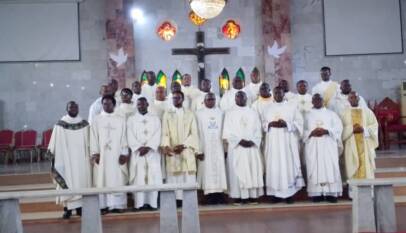



Twenty-five years in vineyard: Celebrating Priestly journey, legacy of Rev. Fr. Sebastian Ngene
By Jerome-Mario Utomi Some anniversaries simply mark the passage of time, and there are an…
